
Lina Khraise (Includovate), Andrea Mrazova (Includovate), and Mousumi Sarkar (Well World Solutions)
Ethical dilemmas are a common and often unavoidable aspect of research in international development. They arise when two or more ethical principles or responsibilities conflict, making it difficult to determine the most appropriate course of action. While formal approval processes, such as Institutional Review Board (IRB) ethical clearance, address some ethical considerations, real-world challenges often emerge during fieldwork, where researchers must make immediate decisions that can directly affect participants and communities. In a recent webinar on ethical dilemmas, our team provided key insights from three perspectives: a professional evaluator, an IRB member, and a research methodologist with expertise in data collection in low- and middle-income countries (LMICs).
Evaluators are often seen as technical experts, but they are also moral agents who must navigate competing ethical principles, power asymmetries, and institutional constraints throughout the evaluation cycle. Their dilemmas rarely have an obvious right-or-wrong answer, only trade-offs between two legitimate priorities. This tension is evident in proposal writing, where evaluators must balance internationally recognised indicators that enable cross-context comparability with the risk of overlooking local understandings of concepts such as empowerment and wellbeing. In practice, evaluators can mitigate this by triangulating standardised indicators with locally grounded qualitative measures, rather than defaulting to one or the other. Without this step, evaluations risk generating data that travels well across contexts but says little about what actually matters to the people it is meant to represent. This tension also arises when choosing between rigorous evaluation designs, such as randomised controlled trials, and more participatory approaches that better capture community priorities and perspectives.
Similar tensions appear in sampling, recruitment, and translation. Including vulnerable groups helps ensure their voices are heard, but participation can expose them to risk. While recruiting through community leaders or implementing partners can improve access to participants, it can also narrow whose perspectives are included. Translation adds another layer, since a literal rendering may preserve accuracy while a more contextualised one better captures participants’ intended meaning.
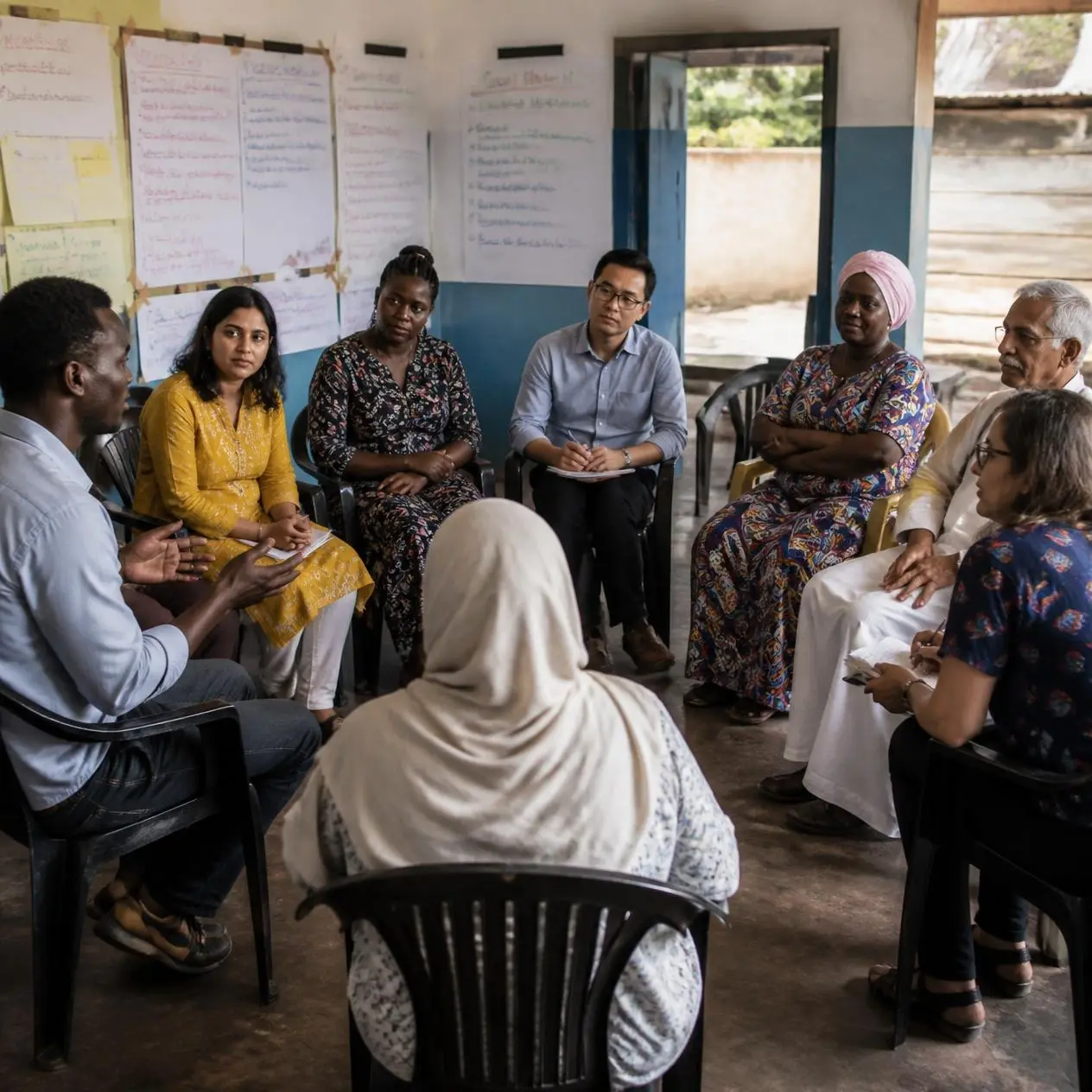
From an IRB perspective, addressing these dilemmas also requires careful consideration of the study context. Common examples include balancing informed consent with cultural norms, such as requiring a husband’s consent in certain cultures for his wife’s involvement in the study. Another dilemma is managing the tension between scientific neutrality and the willingness to personally help participants; for example, when a researcher learns during an interview that a participant is experiencing an immediate material hardship but cannot help without creating an inappropriate researcher–participant relationship. Researchers may also need to assess whether offering remuneration for participation fairly compensates participants for their time or creates undue coercion. These issues can be addressed by anticipating risks and preparing properly, avoiding overpromising, and understanding the boundaries of researchers’ roles.
IRB reviews are important elements in ensuring that research subjects are treated humanely and ethically. However, most studies conducted in LMICs are still being reviewed by IRBs in rich, donor countries. An alternative might be IRBs, such as those operated by private entities like Includovate, composed of diverse members from various countries, cultures, genders, and professional backgrounds, that go beyond liability and gatekeeping to promote ethical best practices. Protocols developed in offices in London, Paris, or Washington, DC can provide valuable guidance, but they often fall short of addressing the complex realities encountered during implementation.
These protocols often do not fully account for the constraints encountered in many LMIC settings, which may differ significantly from those typically experienced in higher-income countries. These constraints include (but are not restricted to) poverty, low literacy, and power imbalances, which can affect informed consent and participation. Further. Gatekeepers, such as village chiefs, control and shape access to households in many contexts. Security risks from militants and armed actors, political repression, and hierarchical family or community structures may further limit participants’ autonomy and ability to participate freely in the research. Many LMICs still operate under more autocratic models where asking certain questions might put participants at risk of harm, and any data breach could potentially have immense consequences. Essential support services, such as mental health hotlines or healthcare clinics for emergency treatment for conditions like malnutrition, are often unavailable or limited in their capacities. Infrastructure to protect confidential data may be weak, leaving it vulnerable to unauthorised access or confiscation by local actors and government authorities. Cultural differences in how concepts such as informed consent are understood add further complexity, requiring context-sensitive and flexible ethical approaches.
To address these challenges, a central principle, particularly for those of us working from donor countries, is to prioritise localisation by partnering with local researchers who understand the social, cultural, and political dynamics on the ground and can handle concerns more effectively and sensitively.
Three questions we should always ask are:
- Who is not in the room and why?
- What is the worst-case harm if the data leaks?
- What can we offer right now (not later)?
We, as researchers, must build an actionable system that is cognisant of ground realities and adaptable to changing (sometimes rapidly) circumstances. The system should include the following basic building blocks:
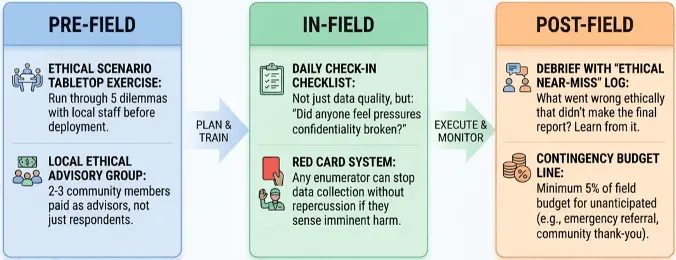
Graph: Ethical Framework Building Blocks for Field Research
When looking at the ethical dilemmas from the three perspectives, we can conclude that all three approaches share the need for a better understanding of local contexts, as this shapes how researchers respond when ethical dilemmas occur. Importantly, ethical dilemmas do not always have perfect solutions. Instead, they require thoughtful judgment, reflection, and accountability. Anticipating risks, developing protocols, and discussing potential dilemmas before fieldwork can significantly improve ethical decision-making. In doing so, we can ensure the research reflects not just what is methodologically strongest but who benefits, who bears the burden, and whose voices might otherwise be left out. While there is no single straightforward solution, researchers can manage these dilemmas by making trade-offs explicit, documenting why they chose certain options over others, and involving participants and local partners in all decisions that affect them.
AI-Generated Images Notice:
The images featured in this blog were generated using artificial intelligence (AI) tools.
Dr Lina Khraise is Principal Researcher at Includovate, where she specialises in inclusive evaluation and learning to advance equitable and inclusive development. She holds a PhD in International Development and Policy Management with a focus on women’s economic inclusion and has expertise in development studies, feminist economics, and sociology. At Includovate, she leads multi-country impact evaluations using mixed-methods and participatory approaches, collaborating with governments, multilateral organisations, and community groups to expand access to education and employment and centre the voices of vulnerable communities in policy and programme design.
Andrea Mrazova is a Vice-Chair of the Includovate Institutional Review Board and Senior Research Associate at Includovate. She holds a Master’s degree in Law and is currently pursuing her PhD at Griffith University, Australia. She brings extensive experience navigating complex field-based research and ethical review processes. With a strong understanding of practical research challenges, she is particularly skilled at connecting real-world field dilemmas to formal IRB requirements, helping ensure ethical oversight that is both rigorous and grounded in operational realities.
Mousumi Sarkar, founder of Well World Solutions, LLC, brings more than 25 years of experience conducting both qualitative and quantitative research and analysis at the international, national, state and local levels to provide solutions to organisations. Having worked with for-profit companies, government agencies, non-governmental organisations, lobbyists, and political campaigns, she has extensive experience working with stakeholders to develop and implement research and evaluation methodologies that answer questions critical to an organisation’s mission and help it use evidence-based decision-making to reach its strategic goals. Most recently, she served as Senior Survey and Evaluation Methodology Advisor at USAID. She also served as Assistant Survey Director at the U.S. Census Bureau and has helmed multiple federal research and evaluation projects as a contractor. In these roles, one of her key responsibilities was ensuring research and evaluation activities were carried out ethically and centred on participants’ physical, mental, and emotional well-being.