
Dr Kristie Drucza, CEO, Includovate
This is part 2 of a blog. Part 1 argued that localisation can widen inequality inside partner countries, and that donors cannot tell whether it is doing so because they do not ask who gains power once the money arrives. This blog looks at what it takes to build an inclusive organisation through a case study of Care in Ethiopia. It asks what measures make it visible, and why diversity, equity, and inclusion targets should complement localisation.
How bias hides in a recruitment process
CARE Ethiopia’s institutional gender reform shows how ordinary hiring practices produce skewed outcomes without anyone intending them. A 2012 global gender audit found the Ethiopia office had the organisation’s worst gender parity, with 26 per cent female staff and only 13.6 per cent female leadership (Drucza, 2018). The cause was not a shortage of capable women. Jobs were being advertised with far greater requirements than the work needed, because programs inflated grades to keep salaries competitive, and those inflated requirements systematically screened women out. Asking for more years of experience than women were likely to have accumulated, given how recently women had begun graduating from local universities, meant the candidate pool was always heavily male, and job descriptions of four or five pages deterred busy women from applying at all. None of this would appear in a compliance report. The vacancies were advertised, and the process was competitive on its face.
What fixing it actually required
CARE Ethiopia set an explicit target of 51 per cent female staff by June 2018 and came close to parity within five years, with some offices projected to exceed 70 per cent female staff (Drucza, 2018). This happened in a country where everyone said it wouldn’t be possible to employ competent women on par with men. The case study demonstrates what is possible, even in a highly patriarchal country. Measurement and commitment were key.
The measures were structural rather than encouraging, and several of them double as anti-nepotism controls (Drucza, 2018):
- Responsibility for grading job descriptions moved from programs to HR, and descriptions were re-graded to ask for fewer years of experience, lower education levels, and only the required skills.
- They re-advertised positions up to three times if no women applied. They moved advertising to places women would see it, including markets and notice boards near field offices.
- Assessment became competency-based, with anonymous written examinations so panels couldn’t see who wrote them, and interview panels had to include a woman.
- A female-only internship programme with a stipend built a pipeline of graduates at the field-office level, costing about USD 40,000 in stipends and training.
- Employment conditions changed alongside recruitment, including maternity leave extended beyond the national requirement, paid paternity leave and flexible hours for school drop-off and pick-up.
Two features of that reform matter most here. First, CARE tracked gender diversity numbers monthly from every field office, allowing it to demonstrate progress, prove process in appeals, and produce evidence when the reforms met internal resistance. Measurement was not a reporting burden bolted on at the end. It was the instrument that made change defensible. Second, the reform did not compromise quality. Reworking the postings widened the applicant pool and raised candidate calibre, and the organisation reports it never had to lower its standards to meet its equity goals. It also took time: the male-dominated senior leadership team took over a year to approve some recommendations, including extended maternity leave (Drucza, 2018).

The indicators donors could ask for
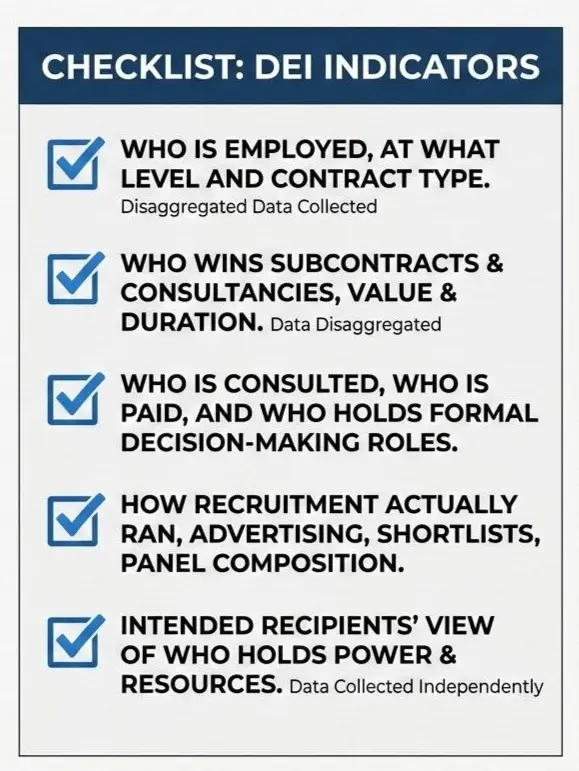
If donors want localisation to close rather than widen equity gaps, they cannot treat it as an unfortunate side effect. It means asking not only how much funding goes to local organisations, but how they recruit, who can genuinely compete for secure roles, and whose lived experience shapes program decisions. Donors need not set the targets themselves. What they can ask is that recipients set them, explain how they were chosen, and report against them:
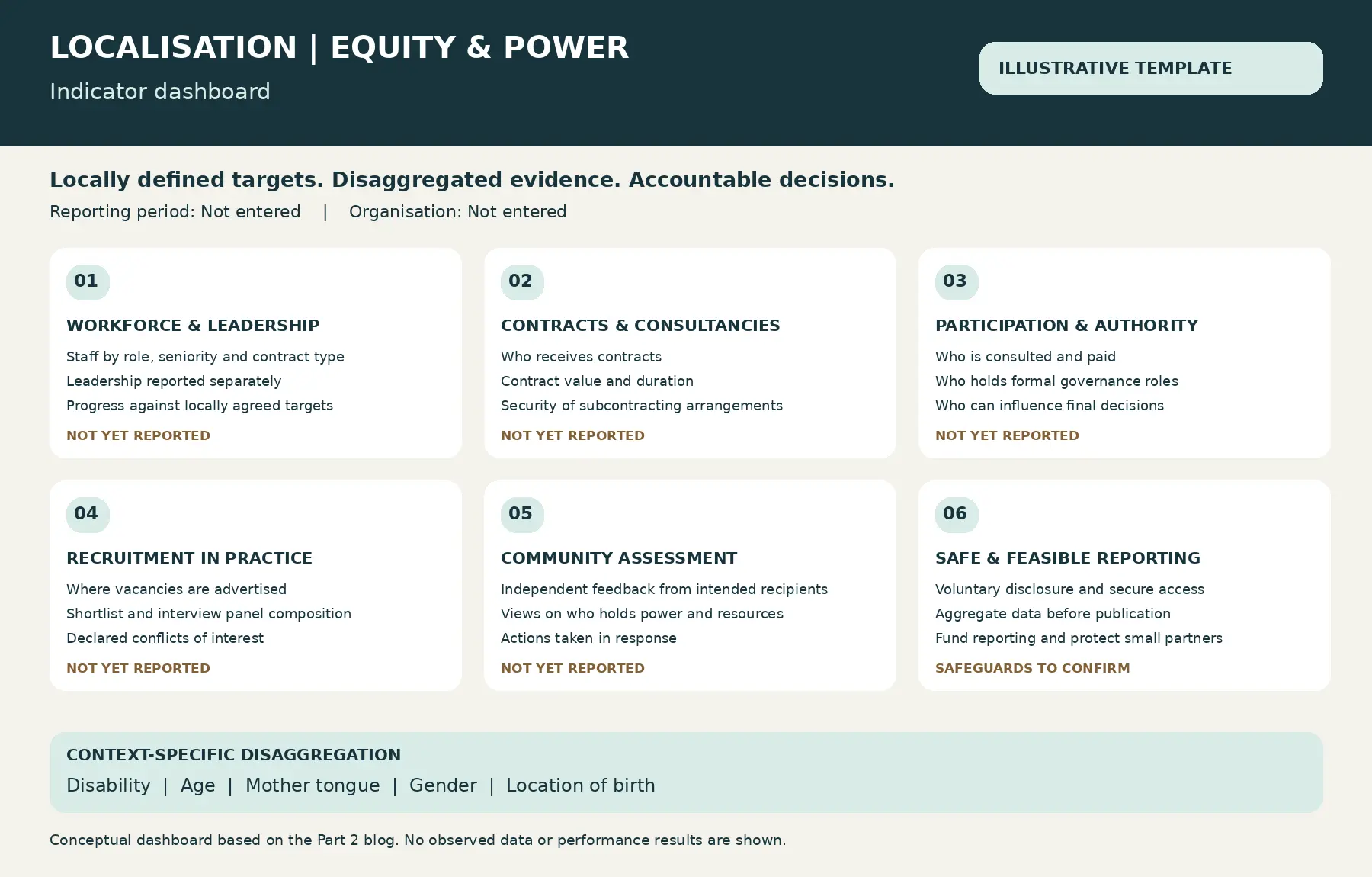
- Who is employed, at what level and on what contract type, disaggregated by disability, age, mother tongue, gender and location of birth, with leadership and decision-making roles reported separately from junior and short-term positions.
- Who wins subcontracts and consultancies, disaggregated the same way, including value and duration, so that subcontracting is not used to keep smaller organisations in precarious roles.
- Who is consulted, who is paid for that participation, and who holds a formal decision-making role in program governance.
- How recruitment actually ran, including where vacancies were advertised, the composition of shortlists and interview panels, and declared conflicts of interest.
- What the program’s intended recipients think about who holds power and resources, collected independently of the recipient organisation.
This kind of reporting is only useful if the categories fit the context, which is why analysis must come first. Political economy and power analysis can examine how gender, disability, ethnicity, caste, and other factors shape access to resources and influence within and between organisations, and marginalised groups should do this work with us, not just about us. We can then set targets and reporting requirements against the fault lines that matter locally. We name mother tongue and place of birth above because they are politically sensitive and carry exclusion in ways that workforce categories in developed economies do not capture.

Turning data into accountability
Embedding these practices in program baselines and monitoring systems creates a feedback loop that makes equity outcomes visible. Communities can see whether localisation is changing who is consulted, who is paid, and who can decide, and donors gain evidence on whether their investments disrupt or entrench domestic hierarchies. Success then means more than the volume of funding channelled to local organisations or the number of local staff in senior roles. It means disaggregated data on who actually benefits, who holds power once the money arrives, and what the intended recipients think.
Two cautions are worth stating plainly. Disclosure carries risk, because data on disability, ethnicity, language or sexual orientation can expose people in contexts where those identities attract discrimination or violence, so collection must be voluntary, aggregated before publication, and governed by clear rules about who holds and uses the data. Reporting also costs money, and unfunded requirements will penalise exactly the small, diverse organisations localisation is meant to strengthen. The remedy is to fund compliance, keep the indicator set short, and hold larger recipients to a higher standard than the grassroots organisations they subcontract to.
The CARE Ethiopia experience suggests this is workable, not aspirational. Once established, monthly tracking of staff composition is administratively light, and the costs were modest against a country programme budget. It worked because someone was accountable for the numbers and because they were used. Without accountability for equity outcomes, localisation risks shifting power between countries while leaving local hierarchies, and the biased recruitment that underpins them, largely untouched. The task is to make sure inequality does not rise alongside the money, and to count what happens when it arrives.
References
- Drucza, K.L. (2018) Case study 2018: CARE Ethiopia’s institutional gender reform. Mexico City: CIMMYT. Available at: https://gender.cgiar.org/publications/case-study-2018-care-ethiopias-institutional-gender-reform