
Dr Kristie Drucza, CEO, Includovate
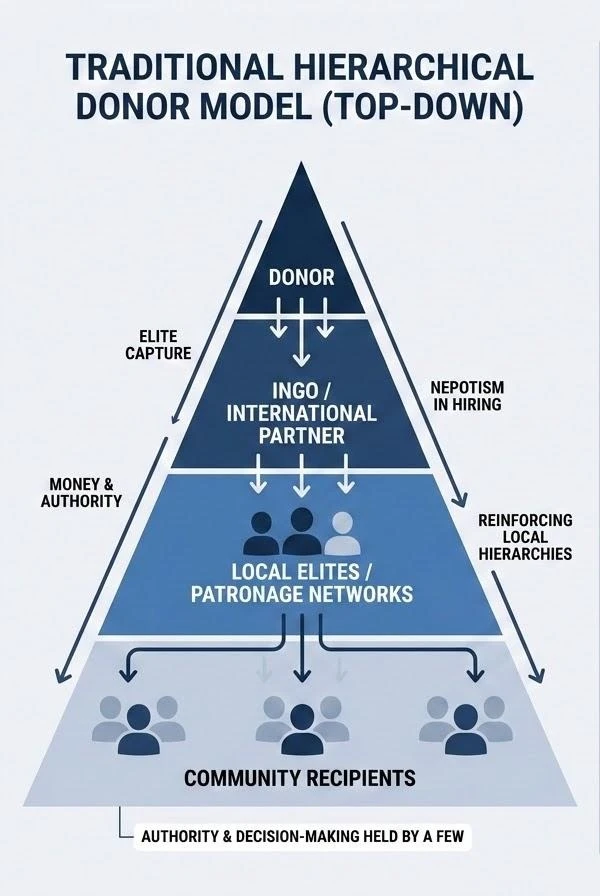
DFAT and other donors are investing significant money and authority in localisation, shifting decisions to local partners in the hope that aid will finally become more effective and sustainable. In many contexts, however, this is deepening inequalities, as well-connected elites step into spaces once occupied by international NGOs and hire from their networks. Australia’s localisation agenda is shifting money and authority to local partners, but without DEI conditions it can widen inequality inside partner countries. The missing link is measurement. Indicators tracking who actually gains power and resources, who is employed within funding-receiving organisations and at what leadership level, disaggregated by disability, age, mother tongue, gender and location of birth, need to be measured and reported back to DFAT.
Concrete at home, loose abroad
DFAT’s Guidance Note on Locally Led Development (DFAT, n.d.) sets out practical steps: co-design with local stakeholders, use local systems for planning and budgeting, and appoint local team leaders. It emphasises respecting the agency, leadership, and decision-making of diverse local actors, and warns against monopolies of resources and decision-making by local elites. Yet it frames this as encouragement rather than obligation: programs are urged to engage diverse local actors, including women’s organisations and Organisations of Persons with Disabilities (OPDs), but it sets no specific DEI targets, affirmative action requirements, or indicators to track who actually gains power and resources.
By contrast, DFAT’s Inclusion, Equity and Diversity Strategy 2024-2027 is much more concrete in its domestic focus (DFAT, 2024). It sets workforce composition goals, including 5 per cent First Nations representation and more equitable overseas postings, and promotes inclusive leadership, accessible workplaces and targeted recruitment (DFAT, 2024). Posts receive detailed templates for inclusion plans, but little evidence shows those tools are adapted for partner-country hierarchies, such as caste, ethnicity, identity, or restrictive gender norms. The department sets affirmative action targets for its own workforce and reports against them. It asks nothing comparable of the organisations it funds.
Commitments that stop at the contract
Across the aid sector more broadly, internal DEI commitments rarely come with matching expectations for partner organisations. Donors seldom require partners to adopt affirmative action in recruitment, run open and transparent hiring processes, or implement robust anti-nepotism safeguards. Contracting checks and balances are in place to prevent corruption and demonstrate value for money, which is why DFAT investigates many fraud complaints every year.
Without applying the same rigour to human resource and recruitment processes as to contracting and finances, localisation tends to funnel money and authority to those who already have status and networks. World Bank research on village governance shows how family ties and patronage can erode accountability and skew access to public resources in Indonesia (World Bank, n.d.).
Advertising a vacancy, which DFAT-funded programs generally do require, does not settle the question. It does not mean the right people are shortlisted, that panels are free of relatives and patrons, or that the successful candidate was not identified over dinner weeks earlier. Recruitment can look competitive while job descriptions circulate through family, friendship and alumni networks long before they appear on any public website. Panels lean on references from known contacts, so affinity bias does the real work: people who look, think and network like existing leaders are read as lower risk and more competent, regardless of their track record. Women, people with disabilities, young people and minority groups do get hired, but mostly into junior, short-term roles with little influence over strategy, hiring or budgets. They often leave burnt out from trying to navigate their own organisation’s politics. Bias also hides in the paperwork itself, in how a job is graded and described, long before anyone sits on a panel.

What happens when nobody counts
A gender audit of the Ethiopian Institute of Agricultural Research illustrates the cost of not measuring. The audit found no sex-disaggregated data on applicants, shortlists, appointments, or promotions, making bias impossible to demonstrate or refute (Drucza, Tsegaye and Azage, 2019). Where practice could be measured, the results were stark: only 17 per cent of survey respondents said their teams aimed to recruit a gender balance among research teams (Drucza, Tsegaye and Azage, 2019). The institute appointed internal gender focal persons who worked part-time on gender, but because it recruited scientists rather than gender experts, no one inside had the standing to change practice (Drucza, Tsegaye and Azage, 2019). The audit also records that the extension system appointed gender advisers based on political affiliation rather than technical capacity (Drucza, Tsegaye and Azage, 2019). This is what elite capture looks like – it appears fine on paper, but without indicators, it is invisible.
The pattern is not confined to one institute. Of six sample international NGOs operating in Ethiopia, all had between 15 and 25 per cent female staff, if they reported workforce diversity figures at all, and only two had gender-specific or affirmative action policies, both recent additions (Drucza, 2018). Organisations that do not publish the numbers cannot be held to them, and donors that do not ask for the numbers cannot know whether their funding is disrupting local hierarchies or reinforcing them.
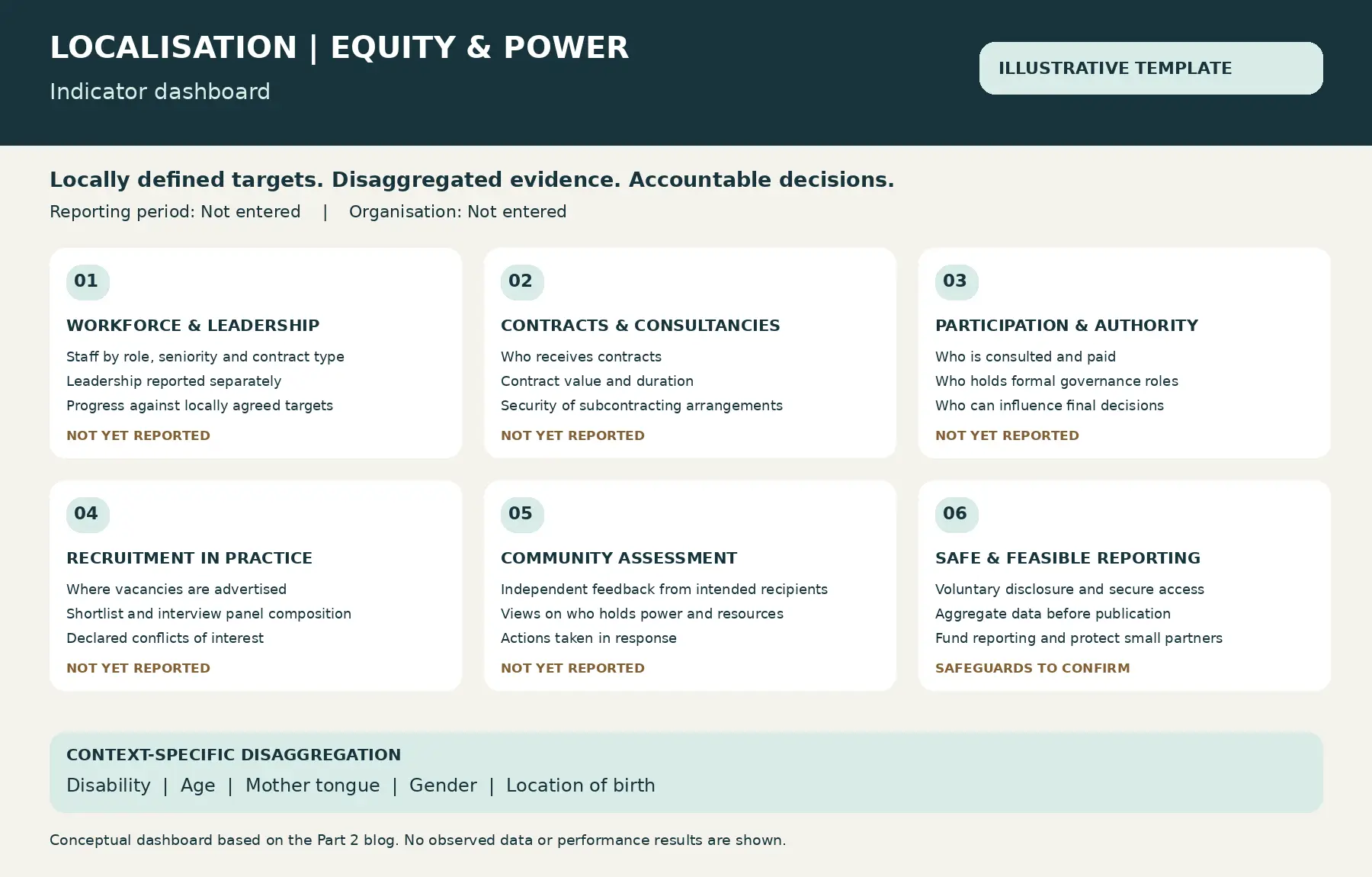
None of this argues for exporting Canberra’s inclusion categories to partner countries. Australian workforce categories miss the fault lines that carry exclusion elsewhere, and imposing them would be both ineffective and presumptuous. The argument is narrower and, I think, harder to refuse: partners should set their own targets and affirmative action measures, informed by national exclusion dynamics and a power analysis conducted with marginalised groups, and donors should require that those targets exist and that progress against them is reported. Part 2 sets out what such measurement looks like in practice, and what donors could reasonably ask recipients to report.
References
- Bond (2024) Beyond the buzzwords: how can we fix localisation to shift power in humanitarian aid? Available at: https://www.bond.org.uk/news/2024/09/beyond-the-buzzwords-how-can-we-fix-localisation-to-shift-power-in-humanitarian-aid/
- DFAT (2024) Inclusion, Equity and Diversity Strategy 2024-2027. Canberra: Department of Foreign Affairs and Trade. Available at: https://www.dfat.gov.au/publications/about-us/inclusion-equity-and-diversity-strategy-2024-2027
- DFAT (n.d.) DFAT Guidance Note on Locally Led Development. Canberra: Department of Foreign Affairs and Trade. Available at: https://www.dfat.gov.au/publications/development/dfat-guidance-note-locally-led-development
- Drucza, K.L. (2018) Case study 2018: CARE Ethiopia’s institutional gender reform. Mexico City: CIMMYT. Available at: https://gender.cgiar.org/publications/case-study-2018-care-ethiopias-institutional-gender-reform
- Drucza, K., Tsegaye, M. and Azage, L. (2019) ‘Doing research and ‘doing gender’ in Ethiopia’s agricultural research system’, Gender, Technology and Development, 23(1), pp. 55-75. Available at: https://doi.org/10.1080/09718524.2019.1616361
- World Bank (n.d.) It takes a village election: turnovers in village elections revitalise local bureaucracies, disrupt nepotistic networks, and improve local government performance. Washington, DC: World Bank. Available at: https://documents1.worldbank.org/curated/en/099537409192440647/pdf/IDU19745253b1b1061406e199e91bfb83d7c7d47.pdf